

My method
Dustless sanding
What does dustless sanding actually mean? The sander is connected to an extractor, and the dust is pulled off the surface through the abrasive itself, at the moment it is made. It goes into a filtered vacuum instead of into the air, the carpet, the curtains and everything else you own.
In practice
What it means in practice
An ordinary sander throws dust. It gets everywhere, and "everywhere" in a house means the top of the picture frames, inside the wardrobe, on the skirting in the next room and through the whole first floor. It carries on landing for days after the sanding stopped.
The system I use extracts at the pad. The abrasive disc is perforated, the backing pad is perforated behind it, and the hose runs to an extractor with filtration fine enough to hold the dust it collects rather than blowing the fine fraction back out of the exhaust — which is what an ordinary workshop vacuum does.
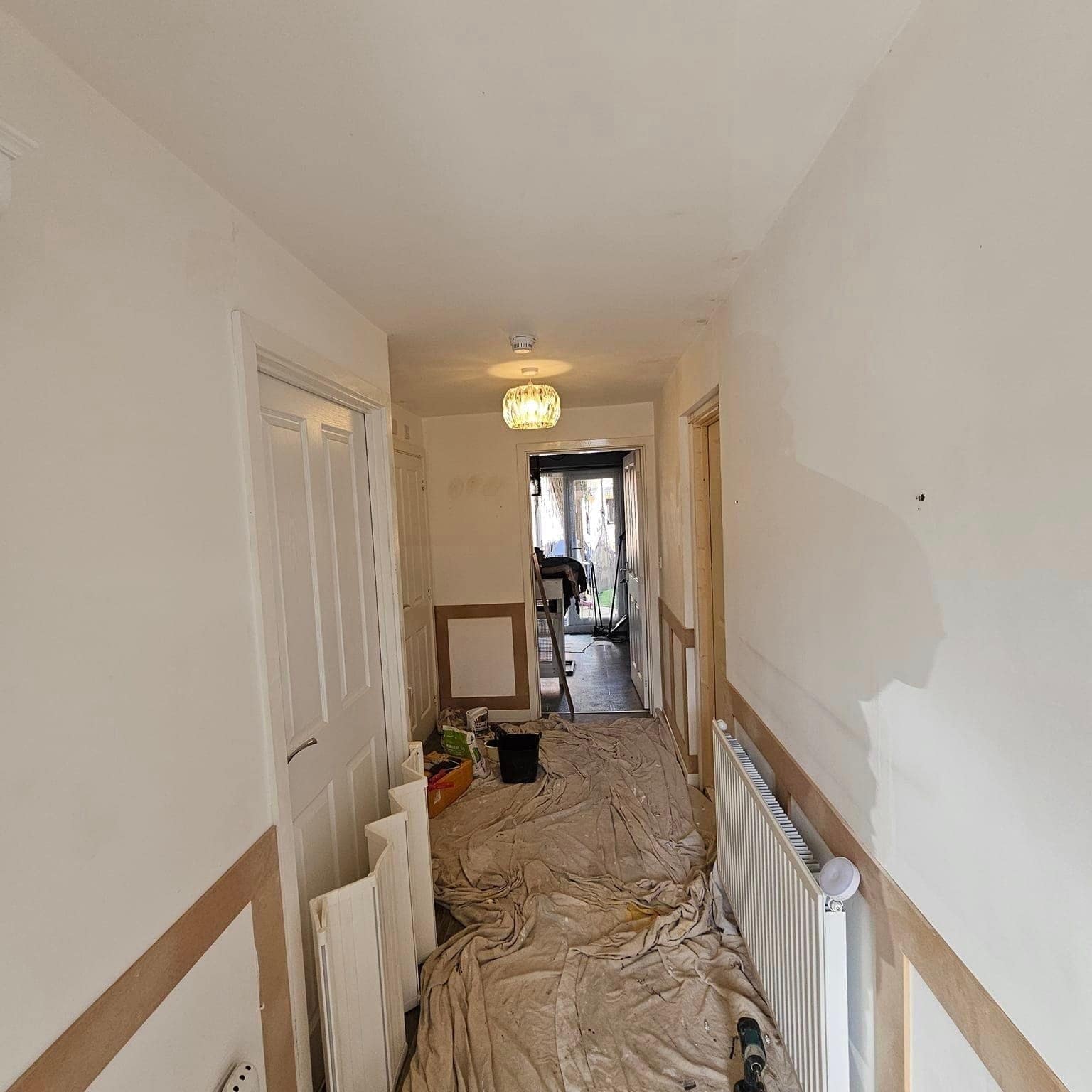
The practical result is that I can sand a whole staircase, or fill and flat an entire ceiling, in a house you are still living in, and at the end of it there is no grey film over the room. You will not need to wash everything down. That is the whole point of it.
Why it matters
Why it matters when you live in the house
You can stay in the house
This is the one that matters. Most decorating dust is made during sanding, and most of the disruption people dread is that dust. Take it out at the source and a repaint stops being something you have to move out for.
Old paint should not be sanded loose
Paint from the middle of the last century may well contain lead, and on older houses in this part of the country there is usually a layer of it somewhere down the stack. Dry-sanding that into the air of a house with children in it is genuinely a bad idea. Extracted at the pad, it goes into the machine.
A dust-free surface takes paint better
Airborne dust has to land somewhere, and if the next thing you do is apply wet paint, it lands in that. Extracting as I sand means the surface I am coating is clean, so the finish is smoother — this is a quality argument as much as a cleanliness one.
It makes the job quicker
Less masking beforehand and far less cleaning afterwards. A day not spent wiping down a house is a day off the job, and that comes off the price rather than going onto it.
What's included
How I set up on your job
- Extraction
- At the abrasive pad, as the dust is made
- Filtration
- Fine-filtered extractor, retained not recirculated
- Used for
- Walls, ceilings, filler, woodwork, staircases
- Suitable with you in the house
- Yes — that is what it is for
- Older paint layers
- Captured rather than put into the air
- Extra cost to you
- None. It is how I work.
- Equipment
- To confirm
Straight answers
Where the word overstates it
“Dustless” is the trade term and it flatters the truth. Here is what it actually does and does not do.
- "Dustless" is the trade word for it and it overstates the case. It captures the great majority of the dust at the point it is made. It is not a sealed laboratory, and anyone who tells you their sanding produces literally none of it is selling.
- Internal corners, mouldings, spindles and beading still need hand-sanding, and a sanding block cannot be connected to an extractor. Those bits make dust, so those bits get sheeted and cleaned as normal.
- Dust sheets still go down. The extraction deals with airborne dust, not with a dropped tin.
- It does not make a sanding job silent. An extractor running alongside a sander is noisy, and if someone is working from home upstairs it is worth planning which room I am in and when.
Free quote
Ask for a price
The extraction is not an extra and it is not a line on the quote — it is how I work on every job. Tell me what needs doing and I will price the decorating.
Or just ring me
- Free, and no obligation attached to it
- Same-day answer, usually
- One job at a time, so the dates are real