

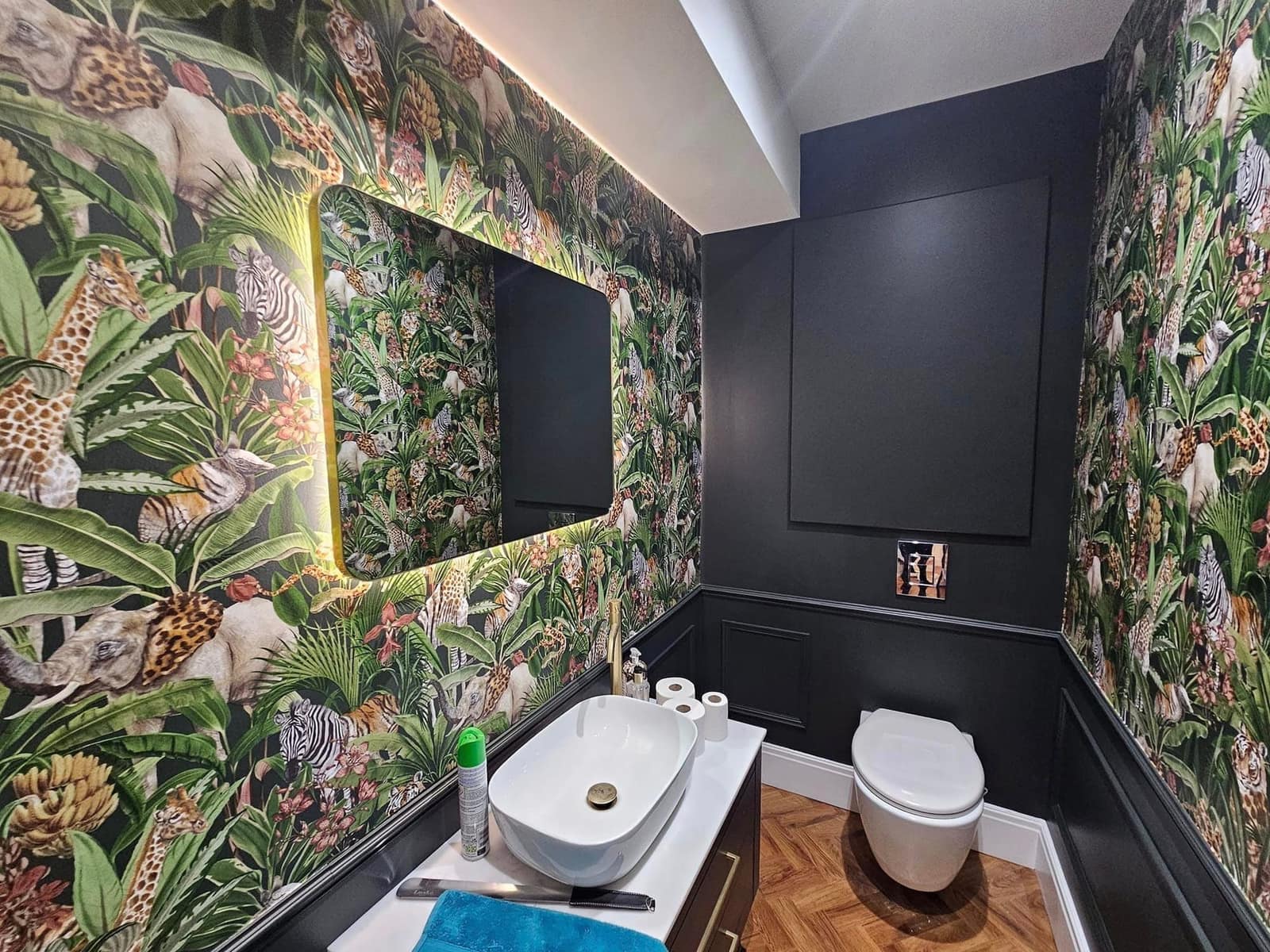
Papering
Wallpaper hanging
Papering is judged on two things: whether the seams show and whether the pattern still lines up at the far corner. Both are decided by the wall underneath and by how carefully the first length was hung.
What it covers
The work itself
- Feature walls and chimney breasts
- Full rooms, hallways, stairs and landings
- Lining paper before painting, on walls that need it
- Patterned and matched papers
- Heavy and delicate hangings — grasscloth, textured, paste-the-wall
- Stripping old paper and making the wall good
How I do it
How I actually do it
In order. The parts you cannot see once it is finished are the parts that decide whether it lasts.
Get the old paper off properly
Stripped back, and the residue washed off rather than papered over. Old paste left on the wall reactivates under new paste and the new paper lifts.
Make the wall flat and consistent
Filled, sanded with extraction, and sized or primed so the whole wall has the same suction. A patch that drinks paste faster than the wall next to it is a seam that opens later.
Set the first length off a plumb line
Not off the corner. No corner in any house is plumb, and if the first drop follows the corner, the pattern leans a little further out all the way round the room.
Plan where the pattern lands
Before anything is cut. Where the repeat falls on the chimney breast, where the join sits relative to the window, and which corner takes the mismatch — because on a patterned paper in a real room, one of them has to.
Butt the seams, roll them down
Edges butted rather than overlapped, brushed out from the centre so no air is trapped, and the seams rolled once the paste has grabbed but before it has set.
Trim clean and wipe down as I go
Sharp blade, changed constantly — a dull blade tears wet paper rather than cutting it. Paste wiped off the woodwork and the ceiling line before it dries, not after.
What's included
What you get for the money
- Preparation
- Strip, wash off, fill, sand, size
- Setting out
- From a plumb line, pattern planned first
- Seams
- Butted and rolled, not overlapped
- Lining
- Where the wall needs it — advised, not assumed
- Short notice
- A single wall can often be fitted in
- Typical feature wall
- To confirm
- Typical room
- To confirm
Straight answers
What it will not do
Worth reading before you book anybody, not just me. A page that only says yes is a page nobody believes.
- Order enough paper, and order it in one go. Batches vary in colour, and a second batch bought a fortnight later can be visibly different in the same room.
- Allow for the repeat when you are working out quantities. A big pattern repeat can waste most of a roll, and running short mid-wall stops the job.
- On a damp wall, paper will not stay up. That is a wall problem and it needs solving first.
- Very old, soft plaster can come away when old paper is stripped. It sometimes cannot be avoided, and if it looks likely I will say so before starting.
- I hang paper. I do not sell it — you buy the paper you actually want, and I will tell you how many rolls you need before you do.
My own photographs
Some of the jobs
Tap any of them to see it larger.
Free quote
Ask for a price
A couple of lines about the job and a town is enough to start with. I will ring you back rather than send a brochure.
Or just ring me
- Free, and no obligation attached to it
- Same-day answer, usually
- One job at a time, so the dates are real